
Impact of BJJ Outreach on At-Risk Youth
BJJ outreach teaches control, discipline and community to at-risk youth, reducing aggression while boosting self-esteem and mental health.
Written by BJJ Academy Finder Editorial Team
Impact of BJJ Outreach on At-Risk Youth
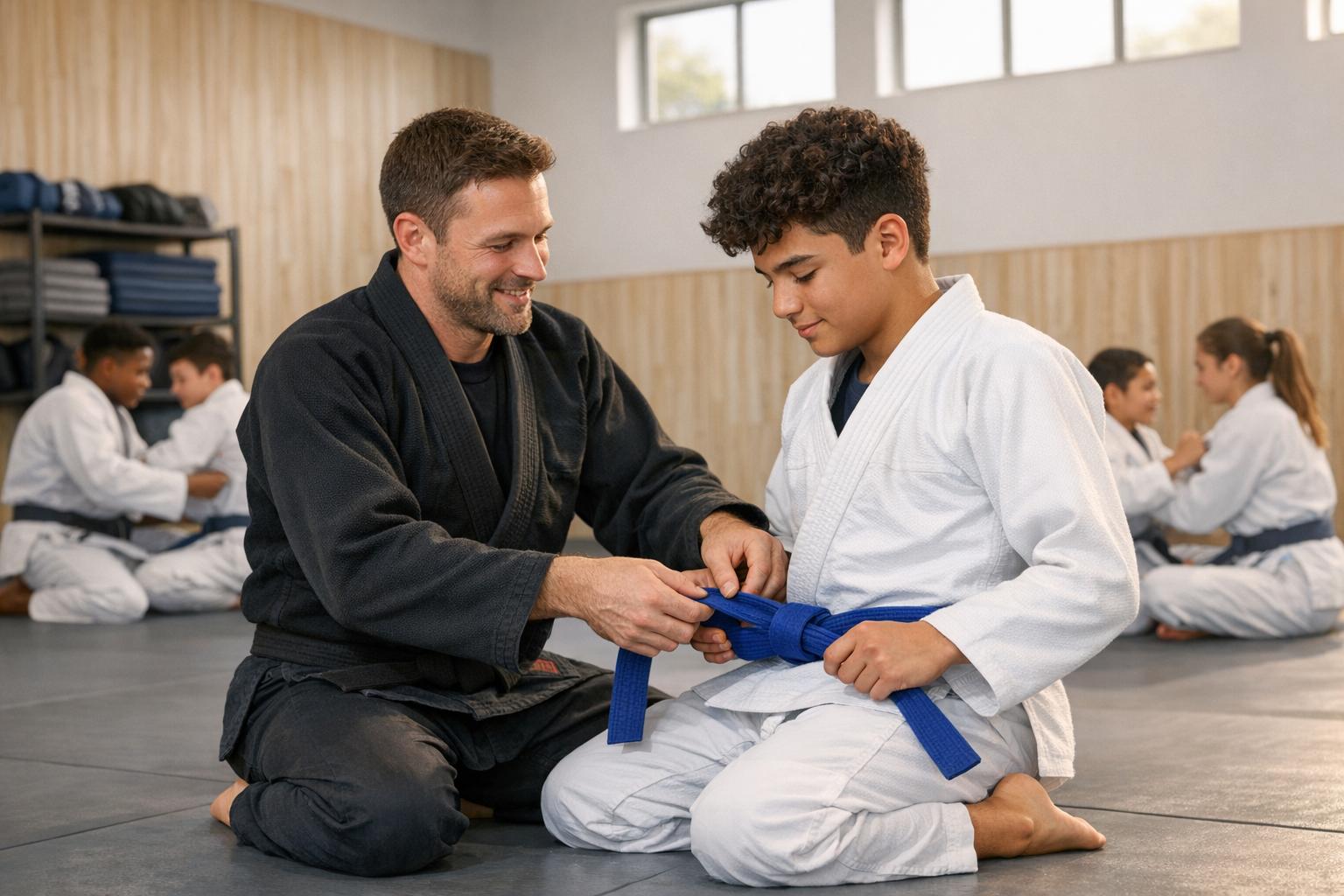
Brazilian Jiu-Jitsu (BJJ) outreach programs are helping at-risk youth by teaching self-control, discipline, and respect through structured martial arts training. These programs focus on safety and mutual support instead of aggression, creating a positive environment for emotional and behavioral growth. Research shows that BJJ can reduce violence, improve self-esteem, and enhance mental health outcomes for young people facing challenges like social isolation, low self-worth, and exposure to violence.
Key Insights:
- Reduced Aggression: Studies show BJJ training improves impulse control and lowers violent tendencies.
- Boosted Self-Esteem: Participants report higher confidence and emotional well-being.
- Cognitive Benefits: BJJ improves processing speed and decision-making skills.
- Supportive Community: The BJJ environment fosters trust, belonging, and positive relationships.
Programs like the Genkai Impact Program combine structured training with life lessons, offering at-risk youth tools to succeed both on and off the mat. Families can find reputable programs through resources like the Brazilian Jiu-Jitsu Gyms Directory, ensuring safe and tailored instruction for their children.
How BJJ Reduces Violence and Aggression
BJJ vs MMA Impact on At-Risk Youth: Aggression and Behavioral Outcomes
Studies suggest that Brazilian Jiu-Jitsu (BJJ) training plays a key role in reducing violent behavior, especially among at-risk youth. Unlike other combat sports, BJJ focuses on control rather than striking, which helps participants develop the self-regulation skills they need to manage aggressive impulses in their daily lives.
BJJ training consistently pushes practitioners to monitor and adjust their actions, which strengthens their ability to control impulses - a skill tied to lower criminal risk and delinquency rates. This process enhances cognitive inhibition, a critical executive function. Brian Moore from Macquarie University's Department of Educational Studies highlights an important distinction between martial arts styles:
"Traditional martial arts emphasize the non-aggressive aspects of martial arts, whereas modern martial arts often stress competition and aggression."
Research backs up these claims with compelling evidence.
Moore et al. (2021): Building Resilience
A randomized controlled trial involving 283 secondary students showed that martial arts training fosters resilience and self-efficacy while reducing internalizing behaviors like depression. The structured nature of BJJ helps participants develop four essential life skills: respect for others, perseverance, self-confidence, and healthy habits. These skills not only improve self-control but also reduce violent tendencies, as participants learn to manage their reactions in high-pressure situations.
Further supporting this, a 2024-2025 study conducted by Liberty University surveyed 420 BJJ athletes across 47 U.S. states. The results showed that black belts exhibited significantly higher levels of resilience, self-control, and life satisfaction compared to white belts. They also reported lower rates of mental health issues. Leandro de Lorenco-Lima, the lead researcher, explained:
"Male Brazilian jiu-jitsu athletes presenting higher self-control, life satisfaction, and resilience, and lower aggression... were more likely to present better mental health than athletes with opposing characteristics."
The study found that psychological factors like aggression and self-control accounted for about 51.7% of the variance in mental health disorders among male participants.
While resilience and mental health benefits are clear, comparative research highlights how BJJ stands out in reducing aggression.
Mickelsson (2019): BJJ vs. MMA Outcomes
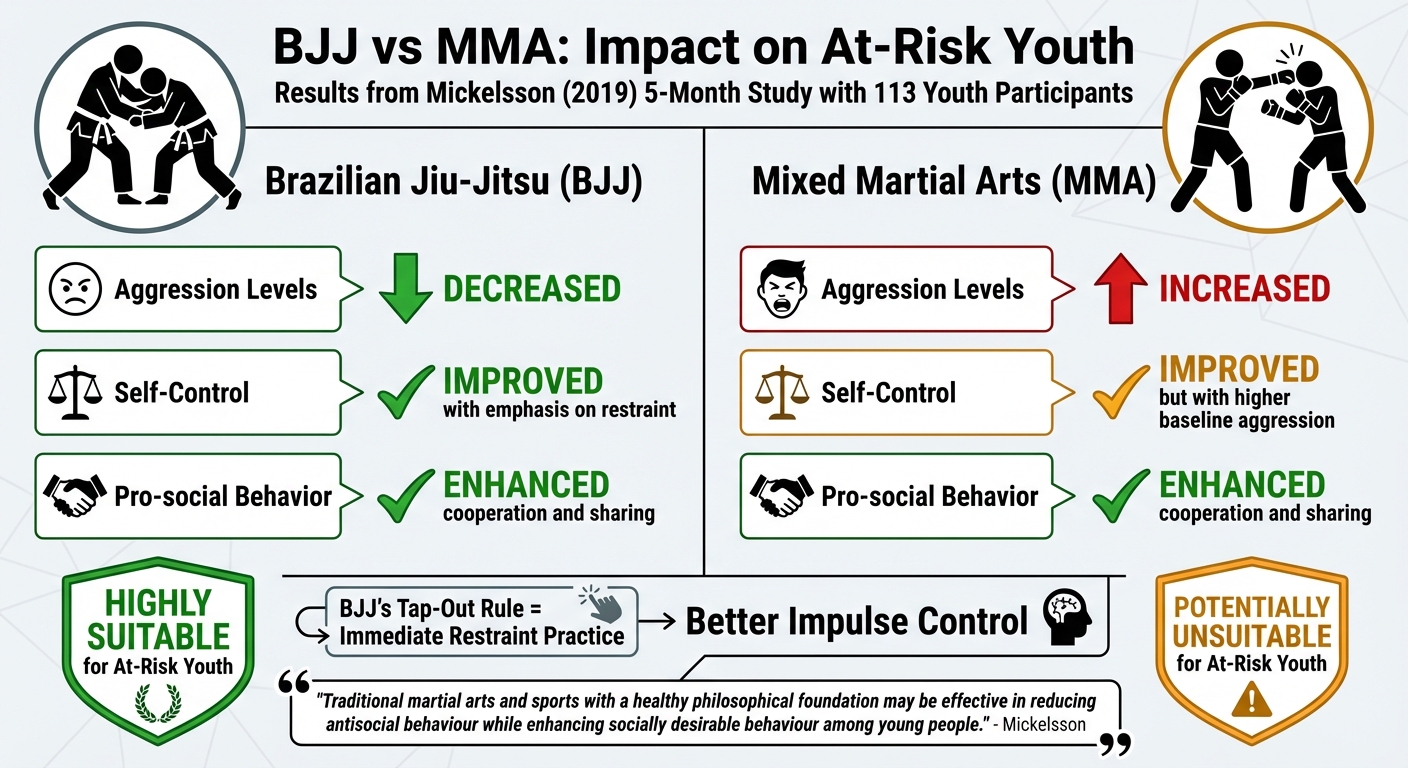
Not all martial arts yield the same results in curbing aggression. Tony Blomqvist Mickelsson's five-month study tracked 113 youth participants enrolled in either BJJ or MMA programs. While both groups showed better pro-social behavior and self-control, only the BJJ group experienced a noticeable drop in aggression. Surprisingly, the MMA group, which started with higher baseline aggression, saw an increase in aggressive tendencies by the end of the study.
| Outcome | Brazilian Jiu-Jitsu (BJJ) | Mixed Martial Arts (MMA) |
|---|---|---|
| Aggression Levels | Decrease | Increase |
| Self-Control | Improved restraint | Improved but with higher baseline aggression |
| Pro-social Behavior | Enhanced cooperation and sharing | Enhanced cooperation and sharing |
| Suitability for At-Risk Youth | Highly suitable | Potentially unsuitable |
Mickelsson attributed BJJ's effectiveness to its philosophical foundation:
"Traditional martial arts and sports with a healthy philosophical foundation may be effective in reducing antisocial behaviour while enhancing socially desirable behaviour among young people."
One of BJJ's defining features - the tap-out rule - requires participants to exercise immediate restraint, a practice that directly translates to better impulse control off the mat. This makes BJJ outreach programs a powerful tool for positively impacting at-risk youth.
How BJJ Improves Self-Esteem and Emotional Health
Brazilian jiu-jitsu (BJJ) does more than just reduce aggression - it also plays a powerful role in improving self-esteem and emotional well-being, especially for at-risk youth. The structured and supportive environment of BJJ acts as a form of psychosocial therapy. Within this setting, the social interactions fostered by training create a protective layer against mental health challenges. Dulce Ruelas from Grand Canyon University highlights how BJJ pushes individuals beyond their comfort zones, helping to ease feelings of stress and self-doubt.
Through repetitive grappling, participants engage in what can be described as a "neural workout", strengthening pathways in the brain that support self-control and emotional regulation. This not only helps with managing emotions but also translates into better behavior in daily life.
Griffiths et al. (2024): Reducing Anxiety Through BJJ
A 2022 study conducted at 12streetjiujitsu in Phoenix revealed impressive results: 87.5% of youth participants reported reduced anxiety, 96.4% of parents observed increased confidence and practical application of skills, and every participant felt a stronger sense of community. This sense of belonging plays a key role in emotional growth. Leandro de Lorenco-Lima from Liberty University's Department of Psychology explains:
"The social interactions with like-minded individuals in the Brazilian jiu-jitsu community may serve as a protective buffer against mental health disorders and promote well-being"
These emotional benefits are closely tied to the development of self-discipline, as seen in further studies.
Blomqvist-Mickelsson (2019): Developing Self-Control and Discipline
Research by Blomqvist-Mickelsson found that five months of BJJ training led to noticeable improvements in self-control and a reduction in aggression among both teenagers and adults.
Additional evidence comes from a six-month intervention led by Anna Harwood-Gross and Yuri Rassovsky in October 2021. This study involved 49 at-risk boys aged 14–17 in specialized education facilities in Israel. Practicing BJJ twice a week, these participants showed marked improvements in cognitive inhibition and processing speed compared to peers in standard physical education classes. Interestingly, initial cortisol reactivity during training predicted later boosts in self-esteem, while oxytocin reactivity was linked to reduced aggression. These findings highlight how self-esteem improvements are intertwined with BJJ's broader behavioral benefits for at-risk youth.
The structured elements of BJJ - such as the tap-out rule, interpersonal rituals, and quick decision-making - help instill discipline as a natural habit. Leandro de Lorenco-Lima underscores this by stating:
"Engagement with Brazilian jiu-jitsu can be life-changing by fostering the acquisition of four critical life skills: respect for others, perseverance, self-confidence, and healthy habits"
Psychological factors like self-control and resilience play a significant role in mental health outcomes, accounting for about 51.7% of the variance in mental health disorders among male participants.
sbb-itb-d583f1e
Successful BJJ Outreach Programs
Brazilian Jiu-Jitsu (BJJ) outreach programs have proven to be effective in promoting emotional well-being, especially for at-risk youth. Studies highlight that structured BJJ programs can lead to noticeable improvements in cognitive skills like inhibition and processing speed, as well as emotional regulation.
Participants in these programs showed enhanced cognitive flexibility when compared to peers in traditional physical education classes. These results were measured using the Cambridge Neuropsychological Test Automated Battery (CANTAB). Interestingly, hormonal responses played a role in predicting long-term benefits: higher oxytocin levels were associated with reduced aggression (p=0.03), while cortisol levels correlated with improved self-esteem (p=0.007). These findings emphasize the tangible benefits BJJ offers for emotional and mental health in real-world scenarios.
Genkai Impact Program
The Genkai Impact Program serves as a great example of how youth-focused BJJ initiatives can make a difference. While specific outcome data for this program is limited, it reflects the key principles that define successful BJJ outreach efforts. Central to these programs is the philosophy of "control without aggression" - teaching participants to handle challenges with leverage and technique, rather than relying on brute strength.
Beyond physical skills, these programs often integrate lessons on character development, focusing on values like responsibility, respect, and compassion. These lessons help participants apply what they learn on the mat to their everyday lives. The belt-ranking system also plays a crucial role, providing young participants with clear, achievable goals that build a sense of accomplishment and foster a strong work ethic.
As Rico from Fight Ready MMA puts it:
"BJJ isn't just a martial art; it's a way of life that can empower young minds and bodies, equipping them with valuable tools for success in the real world".
Additionally, many programs encourage youth to develop "upstander" behavior, giving them the confidence to speak out or intervene in situations like bullying, further extending the benefits of BJJ into their communities.
Finding Quality BJJ Programs
For families interested in enrolling their children in BJJ programs, there are key indicators to look for when evaluating options. High-quality programs often feature age-specific classes, such as Tiny Champions (ages 3-4), Little Champions (ages 5-9), and Juniors (ages 10-15). These tiers ensure that instruction is tailored to the developmental needs of each age group.
Instructor qualifications are also critical. The best programs employ instructors who are experienced in working with at-risk youth and emphasize non-competitive, "soft-contact" training environments. These elements are essential for maintaining the emotional and behavioral benefits that BJJ can provide.
The Brazilian Jiu-Jitsu Gyms Directory (https://bjjacademyfinder.com) is a helpful resource for families looking to find reputable BJJ programs across the United States. This platform offers detailed information about academies, including program descriptions, instructor credentials, and user reviews. With its location-based search and interactive map, families can easily identify nearby options that meet their needs. Networks like Gracie Barra, which has over 700 locations worldwide, often provide free trial classes, allowing families to evaluate the dojo's culture and safety measures before committing. On average, monthly fees for BJJ programs in the U.S. are around $146, though this can vary depending on the region.
Conclusion
Research shows that Brazilian Jiu-Jitsu (BJJ) outreach programs have a profound impact on at-risk youth, significantly reducing violence, boosting self-esteem, and alleviating anxiety. In fact, 96.4% of parents report increased confidence in their children, while 87.5% of participants experience reduced anxiety levels. These outcomes are tied to BJJ's unique combination of disciplined training and supportive community.
BJJ’s emphasis on controlled techniques, such as the immediate release in tap-outs, coupled with measurable hormonal shifts, plays a key role in promoting self-control and enhancing self-esteem. As Weinberger and Burraston explain:
"BJJ is a sport of control and spiritual flow, not violence".
Training typically involves structured sessions 3–5 times per week, which not only build cognitive flexibility and behavioral discipline but also cultivate social connections through partner-based exercises. These elements create an environment where young participants can grow both mentally and emotionally.
To find programs that offer these benefits, families can use the Brazilian Jiu-Jitsu Gyms Directory (https://bjjacademyfinder.com). This resource provides detailed information on instructor qualifications, program offerings, and user reviews, all searchable by location across the United States. Look for academies that focus on youth-specific classes with experienced instructors who prioritize traditional, soft-contact training - an approach proven effective for at-risk youth.
With 100% of participants in community studies reporting stronger social bonds, BJJ programs offer a safe and empowering space where youth can thrive. Explore local academies today and help unlock the potential of these transformative programs.
FAQs
How does Brazilian Jiu-Jitsu help reduce aggression in at-risk youth?
Brazilian Jiu-Jitsu (BJJ) offers a practical way to help at-risk youth manage aggression by teaching them self-discipline, emotional control, and resilience. Through its structured training, BJJ emphasizes techniques that demand patience, focus, and control - qualities that naturally help participants manage impulsive behaviors and reduce hostility in their everyday interactions.
But the benefits of BJJ go beyond just the physical. Training in this martial art creates a sense of community and belonging, which plays a huge role in fostering self-esteem and encouraging positive social behaviors. For many at-risk youth, this sense of connection can be transformative, helping them feel less isolated and more confident. Over time, the combination of these skills and relationships leads to healthier emotional responses and a noticeable reduction in aggressive tendencies.
How does Brazilian Jiu-Jitsu (BJJ) benefit at-risk youth compared to other martial arts like MMA?
Brazilian Jiu-Jitsu (BJJ) shines for its emphasis on personal growth, emotional health, and a strong sense of community, making it a powerful tool for supporting at-risk youth. Through its focus on discipline, self-control, and resilience, BJJ helps participants build confidence, manage their emotions, and steer away from violent behaviors. The structured, encouraging environment creates a sense of belonging while teaching life skills that can make a meaningful difference for young people facing challenges.
By contrast, martial arts like MMA tend to center more on competitive combat and physical conditioning. While these aspects can boost confidence and mental toughness, the intense nature of MMA often involves higher risks of injury and may not align with the rehabilitative and emotional focus that BJJ programs offer. BJJ stands out for its dedication to personal development and community, making it especially effective in fostering self-esteem and reducing harmful behaviors.
What should parents consider when selecting a Brazilian Jiu-Jitsu program for their kids?
When selecting a Brazilian Jiu-Jitsu (BJJ) program for kids, there are a few important things to consider to ensure your child has a safe and rewarding experience. Start by looking at the instructor's qualifications. It's essential to find coaches who not only have experience in BJJ but also know how to work with children. A great instructor will focus on creating a supportive environment while teaching discipline, confidence, and valuable skills.
Look for programs that emphasize character development alongside physical training. BJJ can be a fantastic way for kids to boost their self-esteem, manage stress, and build social skills. Make sure the program includes an age-appropriate curriculum that prioritizes safety, respect, and positive feedback.
Lastly, take a close look at the facility itself. It should be clean, well-maintained, and stocked with proper safety equipment. Reading reviews or hearing from other parents can give you a better sense of the program’s reputation and quality. The ideal BJJ program will go beyond technical training, helping your child grow both on and off the mat.
Related articles
Share this article